Use a single-column, reverse-chronological CV written in British English, kept to one page if you have under three years' experience or two pages beyond that, with sentence-case headings and no tables or graphics. This layout parses cleanly through applicant tracking systems and matches what UK recruiters expect to see within the first half-page. Detailed templates, ATS technicalities and career-stage examples follow below.
TL;DR:
- A reverse-chronological, single-column format is essential for ATS compatibility and ease of reading, with fonts like Arial or Calibri at size 11 or larger.
- Personal details such as full address, date of birth, photo, marital status, and nationality must be omitted to align with UK norms and avoid discrimination.
- Tailoring your CV to include keywords from the job advert and backing each with evidence significantly increases your chance of getting shortlisted.
- Red flags include unexplained gaps, vague duties without results, inconsistent formatting, and unnecessarily long CVs with irrelevant information.
- International applicants should focus on a well-structured CV for ATS inclusion and use role-specific tools to identify UK sponsors and improve application success.
Table of Contents
- What should a UK CV format include section by section?
- Which UK CV format suits your situation: chronological, hybrid or skills-based?
- How do you format a UK CV so ATS software reads it correctly?
- What does a UK CV template look like at each career stage?
- How do you tailor a CV to a specific job advert?
- What are the biggest CV red flags UK recruiters spot instantly?
- Why targeted CVs get more replies, from someone who has looked at a lot of them
- A practical next step for international applicants targeting UK sponsorship roles
- Where to check UK CV guidance for yourself
- Sources
- FAQ
What should a UK CV format include section by section?
A UK CV runs in a fixed order: header, personal statement, skills, work experience, then education. Recruiters scan in that sequence, and ATS software expects those headings in roughly that arrangement too, so departing from it without good reason just makes your CV harder to read on both fronts.
Header. Include your full name, town and postcode (not your full address), a professional email, your mobile number and a LinkedIn URL if it's up to date. Leave out your date of birth, a photo, marital status and nationality. UK employers cannot legally use these details to shortlist you, and including them signals you haven't researched local conventions.
Personal statement. Three to five lines summarising your level of experience, your target role and one or two pieces of hard evidence. Something like "Marketing executive with four years' experience in B2B SaaS, having grown organic traffic by 60% at a 40-person startup" tells a recruiter more in one sentence than a paragraph of adjectives.
Skills. List six to twelve skills that match the language in the job advert, grouped under subheadings (technical, languages, tools) if that helps a hiring manager scan them quickly. Use the exact nouns from the job posting rather than close synonyms, since ATS keyword matching is often literal.
Work experience. Reverse-chronological order, most recent role first. Each role gets a single line for job title, employer and dates, followed by two to six bullets written in the STAR format: what the situation was, what you did, and what changed as a result, ideally with a number attached.
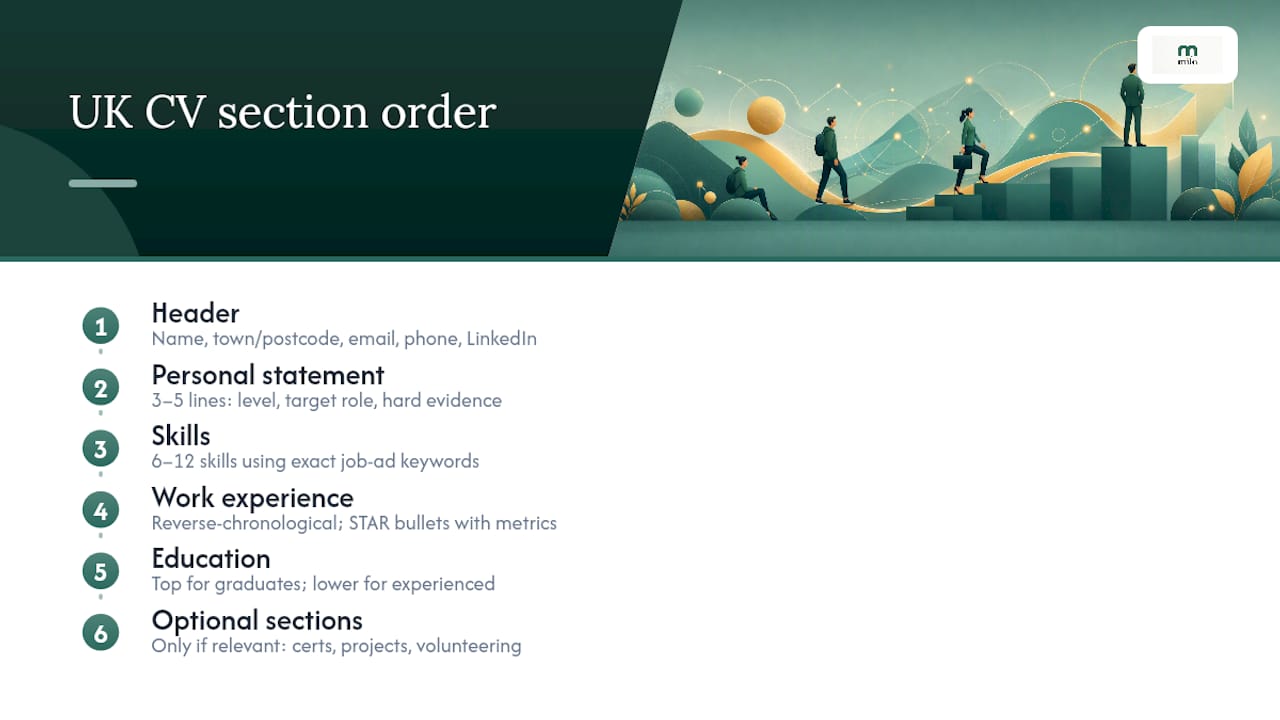
Education. Graduates place this near the top, just below skills. Once you have a few years of paid work behind you, it moves to the bottom and shrinks to institution, qualification and dates, since employers care far more about what you've done since.
Optional sections. Certifications, relevant projects or volunteering earn a place only if they add evidence a recruiter would otherwise miss. A coding bootcamp certificate matters for a junior developer role; a first-aid course from 2015 usually doesn't. The National Careers Service frames this as the same core structure across sectors: contact details, a short introduction, education, and work history, with everything else earning its place through relevance rather than habit.
Which UK CV format suits your situation: chronological, hybrid or skills-based?
Three formats dominate UK applications, and they are not interchangeable.
- Reverse-chronological is the default for good reason. Recruiters expect it, they can scan a familiar structure in seconds, and it's the format ATS platforms are built to parse. Unless you have a specific reason to deviate, this is where you start.
- Hybrid works when your most recent job titles undersell what you've actually done. Career changers, freelancers and people returning from a break often lead with a skills or achievements block, then follow it with a conventional, dated work history underneath. The trick is keeping dates visible throughout. A hybrid CV that hides employment dates to disguise a gap reads as evasive rather than clever, and both recruiters and Modern-CV's own guidance treat that visibility as non-negotiable.
- Skills-based suits graduates with little paid experience or people making a sharp sector switch. The risk is that recruiters sometimes read a skills-only CV as hiding something, so keep a brief, dated work or education history underneath your skills section even in this format.
Career stage should guide the choice more than personal preference. A graduate with two internships benefits from a skills-forward layout that surfaces transferable ability. Someone with fifteen years in the same field gains nothing from hiding their progression, so reverse-chronological wins by default.
Pro Tip: If you're unsure which format fits, draft your CV in reverse-chronological order first. It's easier to lift sections into a hybrid layout afterwards than to force a skills-based CV back into chronological order under deadline pressure.
How do you format a UK CV so ATS software reads it correctly?
Applicant tracking systems reject far more CVs on formatting grounds than on content. A single-column layout is the single most important technical decision you'll make, because ATS software built for platforms like Workday, Greenhouse UK and Reed parses linear text far more reliably than columns, tables or text boxes. A CV that looks sharp with a sidebar and icon-based skills bars can arrive at a recruiter's desk as scrambled fragments, sometimes with entire sections dropped entirely.
The technical rules are short but strict:
- Stick to one column; avoid tables, text boxes, headers, footers and embedded images.
- Use a clean, standard font such as Arial, Calibri or Times New Roman at 11pt or larger, and the National Careers Service backs this as a baseline for readability across both software and human readers.
- Keep headings in sentence case and consistent throughout, rather than mixing capitalisation styles between sections.
- Write dates as DD/MM/YYYY, and use British English spelling throughout, "organise" not "organize", "programme" not "program" for anything that isn't a literal software product name.
- Save as a PDF by default. Some NHS and Civil Service application portals specifically require a
.docxfile instead, so check the advert before submitting, since jobs.ac.uk's guidance flags this as one of the most common submission errors. - Name your file clearly: "FirstName_LastName_CV.pdf" beats "CV_final_v3.pdf" for both ATS parsing and a recruiter's own folder sanity.
None of this is about outsmarting software. It's about giving the same clean information to a scanning algorithm and to the human who reads it thirty seconds later.
What does a UK CV template look like at each career stage?
Structure shifts as your career does. Here's how the skeleton changes.
- Graduate CV (one page). Header, personal statement, education (near the top), skills, then any internships, part-time work or relevant projects. A profile line might read: "Recent economics graduate with a first-class degree and a summer internship in financial analysis, seeking an entry-level analyst role." Keep bullets under work experience or projects tight: what you did, what tool or method you used, what outcome resulted, even if the outcome is a grade or a completed deliverable rather than a business metric.
- Mid-career CV (two pages). Header, personal statement, skills, then work experience with three to five bullets for each of your two most recent roles, dropping to one or two bullets for older positions. Education moves to the final section. An achievement bullet at this stage should carry a number: "Reduced average client onboarding time from three weeks to nine days by redesigning the intake process."
- Senior or executive CV (two pages, occasionally three). A third page is acceptable only when you're summarising fifteen-plus years of relevant, senior-level experience that a recruiter genuinely needs to assess seniority and scope. Compress roles older than ten years into a single line each. Lead with a stronger personal statement that names scale: budgets managed, team sizes, sectors covered.
Two copyable structures worth keeping on file:
- Profile line template: "[Job title] with [X years] experience in [sector/function], known for [core strength], seeking to [specific goal] at [type of company]."
- Achievement bullet template: "[Action verb] [what you did] by [method], resulting in [measurable outcome]."
Both scale up or down depending on career stage. A graduate swaps "measurable outcome" for a grade or completed project; a senior candidate swaps it for revenue, headcount or market share.
How do you tailor a CV to a specific job advert?
Tailoring is a five-minute job if you have a system, and a wasted afternoon if you don't. Here's the repeatable version.
- Read the advert once for context, then again with a highlighter, marking five to eight recurring terms: skills, tools, qualifications, or phrases that appear more than once.
- Map each keyword to a specific place on your CV, your profile line, a skills entry, or a bullet under a relevant role, rather than dumping them into a skills list unsupported by evidence.
- Rewrite one or two bullets under your most recent role using the STAR structure so they speak directly to what the advert asks for. A graduate might write: "Coordinated a five-person student project team, delivering a client report two days ahead of deadline." A mid-career candidate: "Led a cross-functional team of eight to migrate legacy reporting systems, cutting monthly reporting time by 30%."
- Put your strongest, most relevant evidence on page one. Older or tangential experience can sit on page two, since recruiters typically form their initial judgement within the first half-page.
Pro Tip: Never add a skill or keyword you can't back up in an interview. Recruiters routinely ask a follow-up question on anything unusual in your skills section, and a keyword with no evidence behind it does more damage than leaving it off entirely.
What are the biggest CV red flags UK recruiters spot instantly?
Certain mistakes flag a CV as inexperienced or careless within seconds, regardless of how strong the underlying candidate actually is.
- Personal details that don't belong. A photo, date of birth, marital status or full home address all signal unfamiliarity with UK norms, and some recruiters are trained to disregard CVs that include them for compliance reasons.
- Unexplained gaps. A six-month blank on your timeline reads worse than a six-month gap with one honest line attached, such as "Career break for family caregiving" or "Extended travel." You don't owe a paragraph, just enough context to stop a recruiter guessing.
- Vague duties instead of results. "Responsible for managing a team" tells a recruiter nothing. "Managed a team of six, hitting quarterly targets in five of six quarters" tells them everything.
- Inconsistent formatting. Mixed date formats, wandering font sizes, or bullets that sometimes end in full stops and sometimes don't. These look like carelessness, and recruiters treat CV proofreading as a proxy for work quality.
- Overlong CVs padded with irrelevant hobbies or buzzwords. "Dynamic self-starter" says nothing an evidence-based bullet couldn't say better.
- An awkward "references" line. "References available upon request" is standard and safe. Don't list actual referee contact details on the CV itself; that's a step two conversation, not a page one one.
The fix for most of these is a slow read-through the day after you finish writing, when errors are easier to spot, plus consistent tense throughout (past tense for past roles, present tense only for your current one).
Why targeted CVs get more replies, from someone who has looked at a lot of them
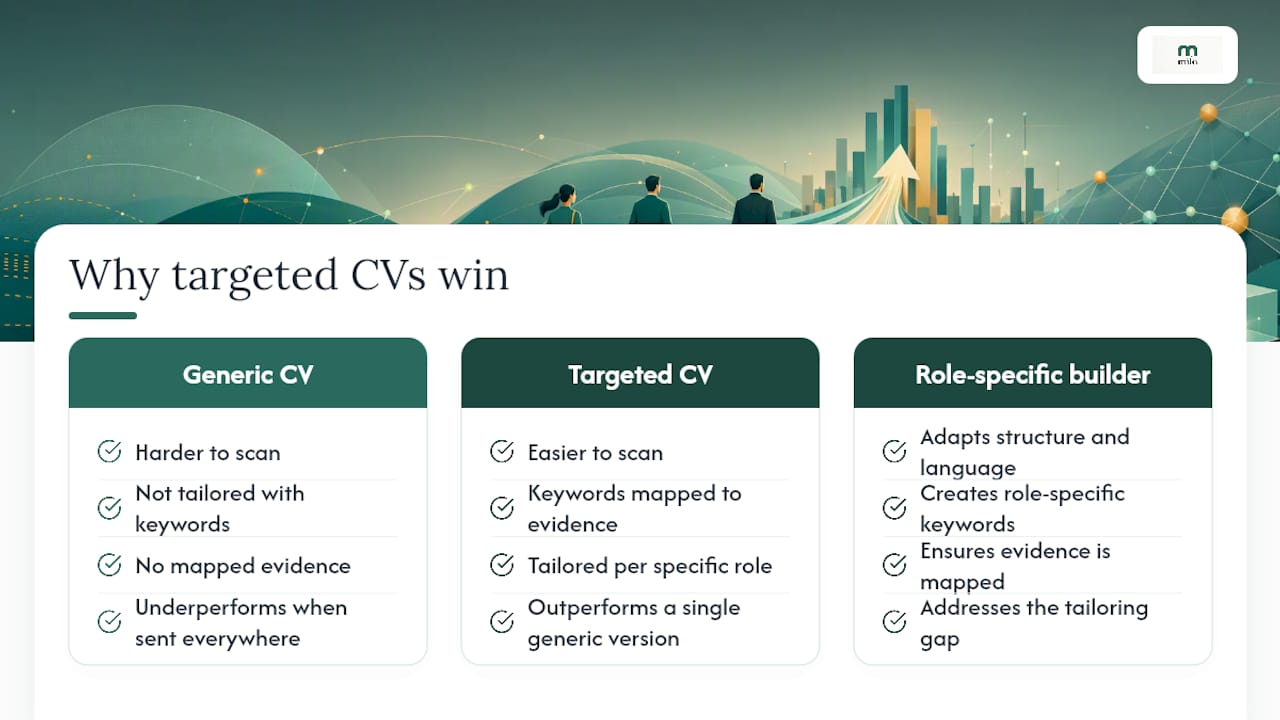
Most CV advice treats formatting as cosmetic. It isn't. A recruiter deciding between two similarly qualified candidates will often shortlist the one whose CV is easier to scan, not the one who's objectively more impressive on paper. That's an uncomfortable truth for candidates who assume substance always wins, but structure is part of substance when someone is reading fifty applications in an afternoon.
The gap most job seekers underestimate isn't formatting, it's tailoring. A CV rewritten for each specific role, with keywords mapped to real evidence, consistently outperforms a single generic version sent everywhere. For international candidates targeting UK sponsorship roles specifically, that tailoring matters even more, since you're often competing against domestic applicants recruiters find administratively simpler to hire. A role-specific CV builder that adapts structure and language per job type, rather than one static template, addresses exactly that gap.
— Sumit
A practical next step for international applicants targeting UK sponsorship roles
Formatting your CV correctly gets you past the first filter. Finding roles that will actually sponsor a visa is the harder problem, and most job boards don't tell you which listings qualify until you've already applied. A platform was built around that specific gap: a CV builder that adapts to individual UK role types, a sponsorship match feature that checks listings against the official licensed sponsor register, and a tracking tool that shows which applications are actually converting into replies.
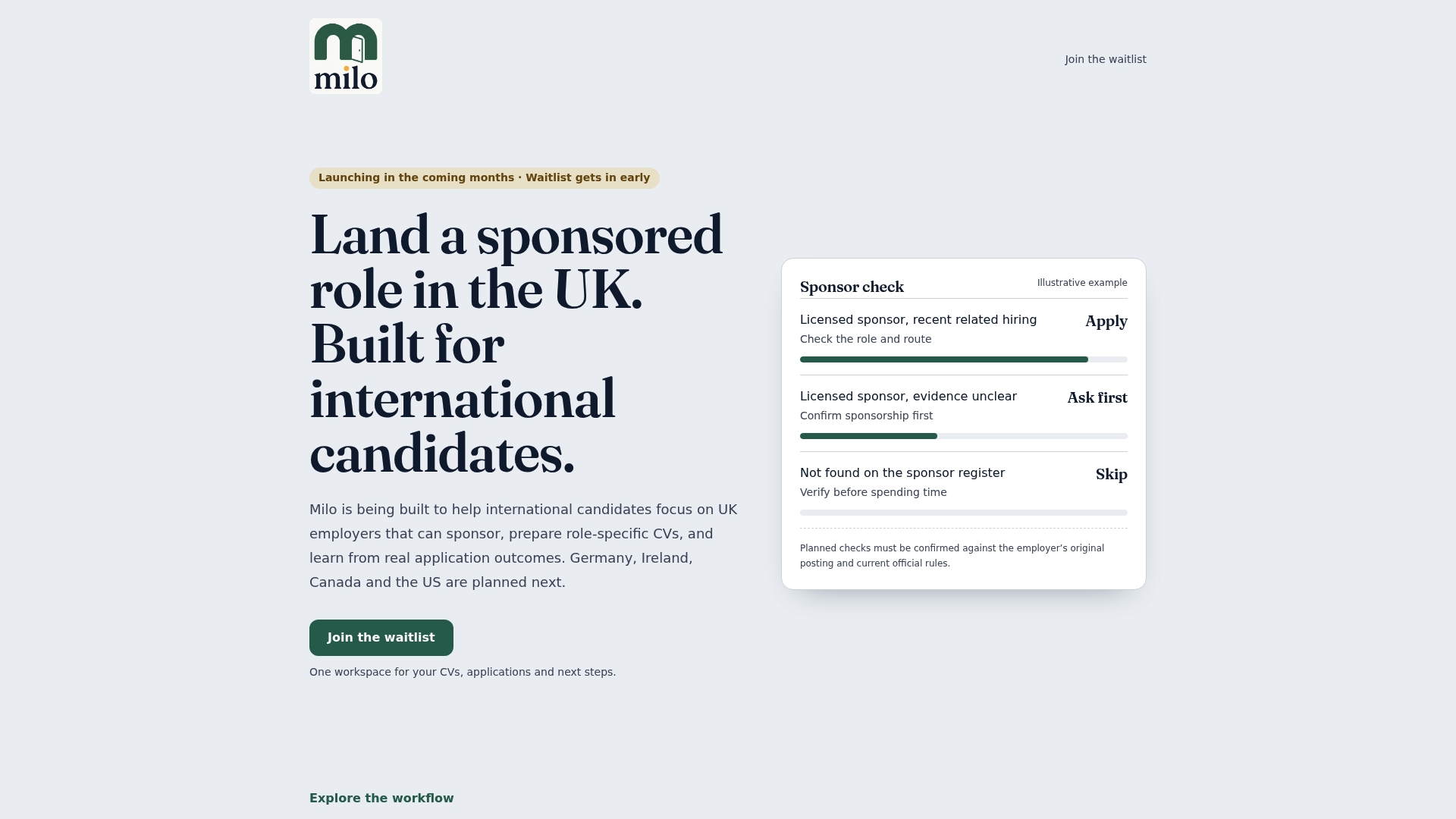
None of this replaces the fundamentals covered above, a well-structured CV still does the heavy lifting. What it changes is how much time you spend guessing which employers can legally sponsor you and how far your tailored version is actually landing.
- Check founding access pre-order details on Milojobs if you want a role-specific CV builder and sponsorship screening built into one workspace rather than assembled from five separate tools.
Where to check UK CV guidance for yourself
The National Careers Service is the clearest government-backed starting point for section-by-section structure. jobs.ac.uk supplies a downloadable ATS-compliant template alongside specific parsing tips. CIPD guidance is worth reading for the recruiter's-eye view of what gets a CV shortlisted in the first place. SpeedCV's 2026 format notes cover sector-specific quirks including NHS and Civil Service conventions, and Modern-CV's UK format guide is a solid reference for hybrid layouts and structure-at-a-glance skeletons.
Sources
No. Writing "References available upon request" is standard practice, and you don't need to include referee names or contact details on the CV itself. Save those for later in the process once an employer actually asks.
- National Careers Service — How to write a CV
- jobs.ac.uk — Free CV template (UK guide)
- SpeedCV — CV format UK 2026
- Modern-CV — UK CV format guide
FAQ
What should a UK CV include?
A UK CV needs a header with contact details, a short personal statement, a skills section, reverse-chronological work experience with measurable achievements, and education. The National Careers Service confirms this order as the standard structure UK employers expect.
How should a CV look in 2026 in the UK?
A single-column layout in British English, one to two pages depending on experience, with clean fonts like Arial or Calibri at 11pt or above and no photo. SpeedCV's 2026 analysis confirms reverse-chronological remains the safest default format for most UK applications.
What are red flags on a CV?
Unexplained employment gaps, vague job descriptions without results, inconsistent formatting, and personal details like a photo or date of birth all raise concerns for UK recruiters. Overlong CVs padded with irrelevant hobbies or generic buzzwords also signal a lack of focus.
What should you not include in a UK CV?
Leave out your photo, date of birth, marital status, nationality and full home address, none of which UK employers can lawfully use in shortlisting decisions. A town and postcode is sufficient contact information alongside your email and mobile number.
How is a UK CV different from a US resume?
A UK CV is typically one to two pages and can include an education section placed higher for graduates, whereas US resumes are usually kept to one page regardless of career stage. UK CVs also strictly exclude photos and personal details that some US resumes still include.