
The Shortage Occupation List can make some roles eligible for a Skilled Worker visa, but only if three things line up: your SOC code sits on the Temporary Shortage List or Immigration Salary List, your employer holds a valid sponsor licence, and your Certificate of Sponsorship meets the correct salary test for that occupation. Miss any one of the three and list inclusion counts for nothing. Check those three items before you spend another hour on an application.
TL;DR:
- Only roles on the Temporary Shortage List or Immigration Salary List qualify, and both the sponsor license and salary requirements must be met simultaneously.
- Since July 2025, roles below degree level need to appear on these lists, qualify under transitional rules, or have a specific carve-out to remain eligible.
- Correctly matching the SOC code based on duties, and ensuring the salary is pro-rated accurately, are critical to avoid application errors or refusals.
- Being on a shortage list does not influence visa fees, processing times, or guarantee approval, but may help sponsors issue Certificates of Sponsorship faster.
- Continuously verify current list statuses, SOC codes, and sponsor legitimacy directly via GOV.UK sources to prevent outdated applications or missed requirements.
Table of Contents
- What the shortage occupation list UK and immigration salary list actually are
- Who qualifies after the 22 July 2025 changes to skilled worker occupation codes
- How to find your SOC code and read the official occupation tables
- Salary rules, going rates and how to pro-rate correctly
- What to check on the Certificate of Sponsorship before you apply
- Common mistakes that cause avoidable refusals
- How to check a sponsor is legitimate using the official register
- How occupations are added to or removed from the shortage lists
- Does shortage list status affect visa fees or the health surcharge
- Does the shortage list speed up visa processing
- What happens if your occupation falls off the list mid-visa
- Staying current as the lists keep changing after 2026
- Why job titles mislead more than sponsors realise
- How Milojobs helps you avoid wasted applications
- Where to check the official rules yourself
- Sources
- FAQ
What the shortage occupation list UK and immigration salary list actually are
The "shortage occupation list UK" that most people search for no longer exists under that name. The Home Office replaced it in 2024 with two separate mechanisms: the Temporary Shortage List (TSL) and the Immigration Salary List (ISL). Both do a similar job, letting certain occupations bypass the standard rules, but they solve different problems.
The TSL exists to plug gaps caused by the July 2025 skill threshold change. It gives temporary breathing room to medium skilled roles at RQF levels 3 to 5 that would otherwise fall outside the Skilled Worker route entirely. Entries on the TSL are not permanent fixtures. Many carry a removal date, after which the occupation stops qualifying unless a Certificate of Sponsorship (CoS) was assigned before that cutoff.
The ISL works differently. Rather than granting access to roles that would otherwise be excluded, it lets specific occupations qualify at a reduced salary, typically 80% of the usual going rate for that job. Several ISL entries are also tied to particular UK nations or to sponsors holding specific regulatory status, most notably care roles requiring Care Quality Commission (CQC) registration in England.
Both lists trace back to advice from the Migration Advisory Committee (MAC), the independent body that reviews labour shortages and recommends which occupations need help attracting overseas workers. The Home Office is not obliged to follow every MAC recommendation, and recent revisions show ministers picking and choosing rather than adopting the advice wholesale.
Here is the practical distinction to keep in mind:
- The TSL answers the question "is this occupation eligible at all?"
- The ISL answers the question "can I qualify at a lower salary than the standard going rate?"
- An occupation can appear on one list, both, or neither, depending on the specific SOC code and sometimes the region.
- Both lists sit alongside, not instead of, the core skilled worker occupation list UK rules in Appendix Skilled Worker.
Confusing the two is the single most common mistake jobseekers make when researching eligibility, because job adverts rarely spell out which list, if any, applies to the role on offer.
Who qualifies after the 22 July 2025 changes to skilled worker occupation codes
Since 22 July 2025, the baseline skill threshold for the Skilled Worker route sits at RQF level 6, broadly equivalent to a UK bachelor's degree. That is a sharp change from the previous RQF level 3 threshold, and it knocked a large number of previously eligible jobs out of the standard route overnight, according to official guidance on the temporary shortage list.
If your role sits below degree level, you now need one of three things to still qualify:
- Your occupation appears on the TSL or ISL. These lists exist specifically to keep certain RQF 3 to 5 roles in the system despite the higher baseline. Lab technicians, welding trades, and several construction occupations fall into this category.
- You qualify under transitional arrangements. Anyone already in the Skilled Worker route, or who held permission before the rule change, may retain access to their previous occupation under transitional protections rather than being forced to meet the new threshold immediately.
- You fall under a special carve-out, such as the separate rules that apply to care workers, who face their own eligibility pathway distinct from the general TSL and ISL framework.
None of these exceptions work alone. Meeting the skill threshold, whether through the standard route or an exception, is only the first of three interdependent tests. You also need a sponsor holding a valid licence for the Skilled Worker route, and a salary that clears whichever going rate applies to your specific SOC code, standard or reduced. GOV.UK guidance is explicit that list inclusion is one element among several, not a substitute for the others.
This is where a lot of otherwise strong applications come unstuck. A candidate finds their job title mentioned somewhere in a shortage list, assumes that settles the matter, and skips checking whether the employer's sponsor licence actually covers that route or whether the salary on offer clears the lower threshold once pro-rated correctly. It usually does not end well.
Transitional arrangements deserve particular attention if you are already working in the UK on a Skilled Worker visa in a role that has since dropped below the new threshold. You are not automatically removed from the country or forced to switch jobs the moment the rules change; the protection generally follows the person already in the route, provided you extend in the same occupation with the same, or a linked, sponsor. Switching employers or occupations after the rule change, however, usually means being assessed against the new criteria from scratch.
How to find your SOC code and read the official occupation tables
Every eligible occupation is tied to a specific SOC 2020 code, a five-digit classification the Home Office uses instead of job titles. This matters more than most applicants realise: two roles with near-identical adverts can map to different codes depending on the actual duties performed, and the Skilled Worker guidance on job matching is blunt about it, the code depends on what you actually do, not what your business card says.
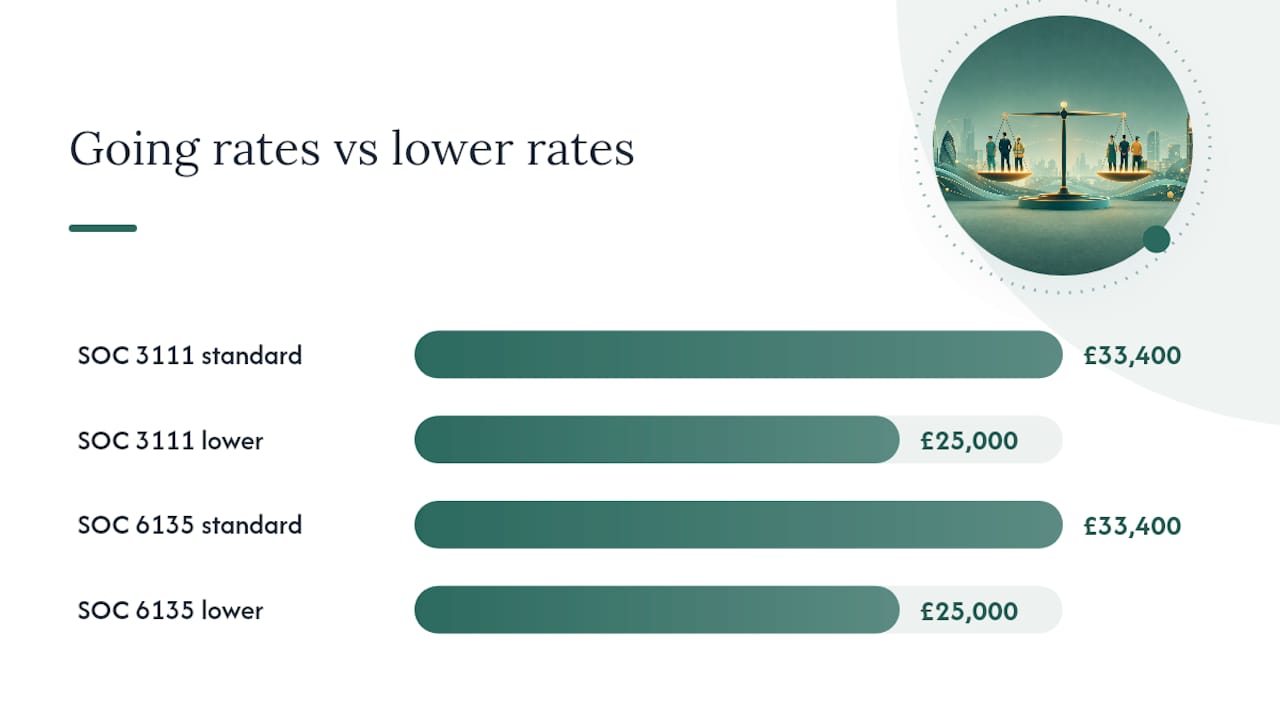
The official eligible occupations and codes table is the master reference. When you open it, look at six columns specifically: the SOC code itself, a description of job types covered, the standard going rate, the lower rate (where applicable), which UK nations the entry applies to, and, for TSL entries, any removal date. Skimming past the removal date column is a common and costly oversight.
A handful of representative examples show how varied these entries can be:
| SOC code | Occupation type | Standard going rate | Lower rate (where applicable) | Notes |
|---|---|---|---|---|
| 3111 | Laboratory technicians | £33,400 | £25,000 | TSL entry; often requires three or more years' relevant experience under ISL conditions |
| 3112 | Electrical and electronics technicians | Set by going rate table | Lower rate applies on TSL | Common TSL inclusion post July 2025 |
| 5213 | Welding trades | Set by going rate table | Lower rate applies on TSL | Frequently used by manufacturing sponsors |
| 6135 | Care workers and home carers | £33,400 (£17.13/hour) | £25,000 (£12.82/hour) | ISL entry; sponsor typically needs CQC registration in England |
These figures come from the temporary shortage list and immigration salary list tables directly, and the gap between standard and lower rates is not trivial. For SOC 3111, that difference could be decisive for whether a mid-career technician on a modest salary actually clears the bar.
To find your own code, the Home Office points applicants towards CASCOT (Computer Assisted Structured Coding Tool), a search tool that matches job descriptions to SOC codes based on duties rather than titles. A few tips make this process faster:
- Search using the core tasks you perform daily, not your job title or department name.
- If your role spans multiple functions, code against whichever duties take up the majority of your time.
- Cross-check the code against the "job types" description in the official table, not just the code number, since Home Office descriptions are sometimes narrower than the general SOC definition suggests.
- Where a role could plausibly sit under two codes, ask your prospective sponsor which one they intend to use on the CoS, since this decision is theirs, not yours.
Getting the code wrong is not a minor clerical slip. It can mean applying against the wrong going rate entirely, or discovering during the visa application that the occupation you believed was on the ISL was never actually assigned that code by your sponsor.
Salary rules, going rates and how to pro-rate correctly
Every eligible occupation carries a "going rate", the minimum salary the Home Office expects for that role based on Annual Survey of Hours and Earnings (ASHE) data. For most occupations you must meet 100% of this figure. Where an occupation sits on the ISL, or in some TSL cases, that requirement drops to a lower rate, commonly around 80% of the standard figure, though the exact percentage and eligibility conditions vary by SOC code and are set out entry by entry in the official tables.
Sample salary comparison: for SOC 6135 (care workers), the Immigration Salary List sets a standard rate of £33,400 (£17.13 per hour) against a lower rate of £25,000 (£12.82 per hour). That is a substantial reduction for a sponsor able to justify the ISL entry.
Pro-rating trips up a surprising number of applicants, particularly those working non-standard hours. The principle is simple: if the going rate is set for a 37.5 hour week and you work fewer hours, your salary must be scaled proportionately, not compared directly against the full-time figure. The formula runs like this:
(Your contracted weekly hours ÷ 37.5) × the applicable going rate = your minimum required salary
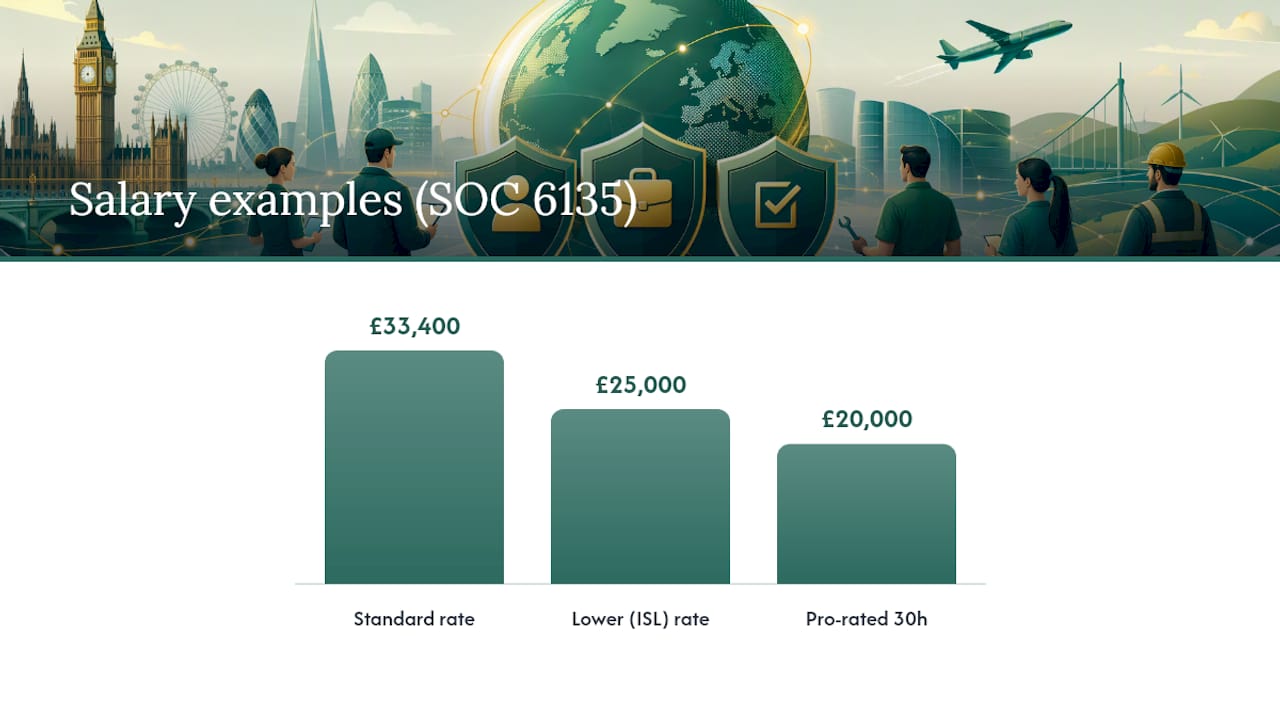
So someone contracted for 30 hours a week against SOC 3111's lower rate of £25,000 would need a salary of at least £20,000, not the full £25,000. Get this calculation wrong, in either direction, and Home Office caseworkers will flag it.
A few points worth keeping in mind when checking your own numbers:
- Overtime pay generally does not count towards the going rate calculation unless it is guaranteed and contractual.
- Allowances and benefits in kind usually do not count either; caseworkers look at basic gross salary.
- Always ask your sponsor to show you the exact calculation they used on the CoS, rather than assuming a headline salary figure automatically clears the bar once hours are factored in.
Sponsors sometimes get this wrong themselves, particularly smaller organisations issuing their first few Certificates of Sponsorship. Checking the arithmetic yourself, before you submit, costs nothing and can save weeks of delay.
What to check on the Certificate of Sponsorship before you apply
A Certificate of Sponsorship is not a formality your employer rubber-stamps. It is the document that formally confirms, in writing, which occupation code you are being sponsored under, whether that code relies on TSL or ISL inclusion, and what salary is being offered against the relevant going rate. Getting this wrong on the CoS itself is one of the most preventable causes of refusal, and the Immigration Rules treat CoS accuracy as central to the whole eligibility test.
Before you rely on a job offer, work through this checklist with your sponsor:
- Confirm the exact SOC code the CoS will use, and ask them to explain why they chose it over any similar code, particularly if your duties could plausibly sit under more than one classification.
- Ask whether the role relies on TSL or ISL status, and if so, request written confirmation of which specific list entry applies, since some occupations sit on both with different conditions attached.
- Check the CoS issue date against any removal deadline. Some TSL entries only remain valid for CoS documents assigned before a specific date; a CoS issued the day after that cutoff will not carry the same eligibility, regardless of when you actually submit your visa application.
- Request evidence of any additional criteria being met, such as the three-plus years' relevant experience some ISL entries require for roles like laboratory technicians, or CQC registration for care sector sponsors.
- Confirm the working address matches what appears on the CoS, particularly relevant for ISL entries that carry regional restrictions, since a mismatch here is a common and avoidable red flag.
If a sponsor cannot answer these questions clearly, that is itself useful information. It usually means they are unfamiliar with the specific list conditions attached to your occupation, and unfamiliarity at this stage tends to translate into errors on the actual CoS.
Common mistakes that cause avoidable refusals
Most refusals connected to shortage list eligibility trace back to a small number of recurring errors, not to genuinely borderline cases. The Skilled Worker caseworker guidance flags incorrect pro-rating for part-time or non-standard hours as a particularly frequent issue, often because neither the applicant nor the sponsor documented the calculation clearly enough for a caseworker to follow.
Other patterns show up repeatedly:
- Assuming a job advert mentioning "shortage occupation" is accurate or current, when in reality lists change and adverts often go stale within weeks.
- Selecting a SOC code based on job title similarity rather than matching actual duties against the official description.
- Treating list inclusion as automatic eligibility, without separately verifying the sponsor's licence status or the specific salary requirement for that code.
- Relying on a sponsor's verbal assurance about ISL or TSL status rather than requesting it in writing before accepting the offer.
Pro Tip: If you work part-time or irregular hours, write your own pro-rata calculation into your covering evidence, showing the exact formula and figures used. Do not assume your sponsor's HR team will document this clearly on your behalf. It takes five minutes and removes one of the most common reasons caseworkers query an application.
Practitioners consistently recommend a short verification routine before accepting any offer: check the sponsor register entry yourself, ask for the specific CoS fields in writing, map your duties against the official SOC description rather than your job title, and keep dated evidence of any experience requirement the role depends on.
How to check a sponsor is legitimate using the official register
Every organisation authorised to sponsor Skilled Worker visas appears on the Register of Worker and Temporary Worker licensed sponsors, published as a downloadable CSV and updated regularly. Before you invest time tailoring an application, search the register for the employer's exact name.
Two columns matter more than any other: Route and Rating. The Route column confirms whether the sponsor's licence actually covers Skilled Worker, since some organisations hold licences for other routes only. The Rating column shows whether they hold an A rating (compliant) or B rating (under scrutiny, sometimes barred from issuing new certificates until issues are resolved).
- Search the CSV by exact company name, since trading names sometimes differ from the registered sponsor name.
- Confirm the town listed matches the actual working location on offer.
- Treat a B rating as a reason to ask direct questions before proceeding, not an automatic disqualifier.
Manual checking involves cross-referencing job listings against the register to determine whether a sponsor's licence status supports the role being advertised.
How occupations are added to or removed from the shortage lists
The Migration Advisory Committee drives most changes to both the TSL and ISL, reviewing labour market data, vacancy rates, and evidence submitted by industry bodies before recommending which occupations genuinely face recruitment shortfalls that domestic training cannot quickly fix. The Home Office then decides whether to accept, modify, or reject each recommendation, meaning list changes are as much a political decision as an economic one.
Occupations typically get added when an industry can demonstrate sustained vacancy rates alongside evidence that raising wages or investing in domestic training has not resolved the shortfall within a reasonable timeframe. Removal tends to happen for the opposite reason: either the shortage has eased, often because domestic recruitment or automation reduced reliance on overseas workers, or the entry was always intended as temporary and its scheduled removal date has simply arrived.
This is precisely why the TSL carries "temporary" in its name. Several entries were designed from the outset with built-in expiry, giving the labour market time to adjust rather than creating permanent reliance on sponsored overseas recruitment. The practical consequence for jobseekers is that a shortage occupation list UK entry you rely on today may not exist in the same form twelve months from now, which makes checking the current list at the point of application, not relying on older research, genuinely essential.
Reviews do not follow a fixed annual calendar. The MAC conducts both scheduled and ad hoc reviews depending on labour market pressures, so changes can land with relatively little advance warning.
Does shortage list status affect visa fees or the health surcharge
List inclusion itself does not automatically reduce your visa application fee or your Immigration Health Surcharge (IHS) liability. These charges are set separately under the general Skilled Worker fee structure and depend primarily on the length of your visa and whether you are applying from inside or outside the UK, not on whether your specific occupation sits on the TSL or ISL.
Where shortage list status has a real financial impact is indirect, through the salary threshold itself. Because ISL and some TSL entries permit a lower going rate, they can make a role financially viable for smaller employers who could not otherwise afford to sponsor at the standard salary, which in turn expands the pool of jobs realistically open to overseas applicants. That is a meaningful practical effect even without a direct fee discount.
It is worth noting that broader Skilled Worker fee and surcharge levels change periodically as part of wider immigration policy updates, independent of which occupations sit on the shortage lists. Always check current fee tables directly on GOV.UK rather than relying on figures from job adverts or older articles, since these numbers shift more frequently than the occupation lists themselves.
Do not assume that a role's TSL or ISL status entitles you to any waiver or discount beyond what applies to Skilled Worker applicants generally. If a sponsor or advertisement implies otherwise, treat that as a signal to verify directly with official guidance before proceeding.
Does the shortage list speed up visa processing
Shortage list status does not grant priority processing in the way that, say, paying for the Home Office's priority or super priority service does. Standard Skilled Worker processing times apply regardless of whether the underlying occupation sits on the TSL, the ISL, or neither.
Where list inclusion can indirectly influence your overall timeline is earlier in the process, at the recruitment stage. Employers sponsoring roles on the shortage lists sometimes move faster to assign a Certificate of Sponsorship precisely because they know time-limited entries carry removal dates, and a sponsor racing against an approaching cutoff has an obvious incentive to issue your CoS promptly rather than let paperwork drift.
That urgency cuts both ways. A sponsor rushing to beat a removal deadline is also more likely to make errors in haste, whether in the SOC code selected, the salary calculation, or the additional criteria documentation an ISL entry might require. If your sponsor tells you they need to move quickly because of an approaching shortage list deadline, treat that as a prompt to double check the paperwork carefully, not a reason to skip your own verification steps.
Paying for priority or super priority processing remains the only reliable way to influence how quickly your actual visa decision comes through, and that service operates entirely independently of shortage list status.
What happens if your occupation falls off the list mid-visa
If your occupation is removed from the TSL or ISL while you already hold a Skilled Worker visa in that role, you are not immediately at risk of losing your status. The transitional protections that generally apply after rule changes tend to extend to list removals as well, meaning your current permission usually remains valid for its granted duration even after the underlying list entry disappears.
The complication arises at extension or renewal. If you want to extend your visa in the same occupation after it has dropped off the relevant list, you may need to demonstrate you qualify under whatever rules apply at that point, which could mean meeting the standard RQF level 6 threshold and full going rate rather than the reduced terms you originally relied on. This is precisely the scenario where transitional arrangements matter most, and precisely why terms change frequently enough to catch people out.
Your best protection is early awareness, not last-minute scrambling. Set a reminder to check the current TSL and ISL status of your occupation a good few months before any extension application, giving yourself time to negotiate a salary adjustment with your employer if the reduced rate no longer applies, or to explore whether a different, still-eligible SOC code better reflects your actual duties.
Employers sponsoring workers under shortage list terms carry some responsibility here too, since a sponsor with genuine intent to retain staff should be tracking list changes on your behalf. Do not assume they are doing so without asking directly, given how easily this detail slips through the cracks at busy HR departments juggling multiple sponsored employees across different occupation codes.
Staying current as the lists keep changing after 2026
The pace of change since the 22 July 2025 threshold shift suggests further revisions are likely rather than settled policy. The MAC continues reviewing labour shortages on an ongoing basis, and given how recently the TSL and ISL structure replaced the old shortage occupation list model, additional adjustments to which occupations qualify, and at what salary, should be expected over the coming months and years rather than treated as a rare event.
The single most reliable habit is checking the official GOV.UK pages directly at the point you are preparing an application, rather than relying on job adverts, recruitment agency summaries, or older articles that may reference an outdated list version. Given that some TSL entries carry hard removal dates tied to CoS issue dates, a list that was accurate when you started your job search could easily have shifted by the time you are ready to apply.
Set a recurring reminder to revisit the specific SOC code relevant to your target occupation every few months, particularly if you are still job hunting rather than holding a confirmed offer. Bookmarking the primary GOV.UK guidance pages, rather than secondary sources discussing them, remains the most dependable way to catch changes as they happen.
Why job titles mislead more than sponsors realise
Employers and recruiters treat TSL and ISL entries as a practical tool for widening their candidate pool when domestic recruitment has stalled, not as a checkbox exercise. In practice, that means many sponsors advertise roles loosely, using whatever job title attracts applicants, without necessarily anchoring that title to the precise SOC code they will eventually use on the CoS.
This is exactly why tailoring your CV and application to the actual duties described in the SOC classification, rather than chasing the job title itself, tends to produce stronger results. A sponsor assessing candidates against a "laboratory technician" advert is ultimately matching applicants against SOC 3111's task description, and a CV that mirrors that language, evidencing the specific duties and, where relevant, the years of experience an ISL entry might require, reads as a far stronger fit than one built around generic job title keywords. Candidates who understand this distinction consistently present better applications than those relying on title matching alone.
— Sumit
How Milojobs helps you avoid wasted applications
Verifying sponsor status and occupation code eligibility manually means cross-checking job adverts against the official register, the TSL, the ISL, and the eligible occupations table separately, for every single role you consider. That is hours of work most jobseekers cannot spare, particularly when juggling multiple applications at once.

Milojobs pre-screens job listings against the official licensed sponsor register and highlights indications that a role's Certificate of Sponsorship terms align with current TSL or ISL status, so you spend your effort on roles that are actually viable rather than adverts that look promising but fall apart on closer inspection. The platform also includes a role-specific CV builder that tailors your application to the actual SOC code duties rather than generic job title language, plus an application outcome tracker so you can see what is working across your search rather than guessing. Founding access is currently available as a one-time pre-order for three months of platform access, with no automatic renewal. If you are actively applying for sponsored roles right now, that is the moment to check availability and secure your place.
Where to check the official rules yourself
Every figure and rule in this guide traces back to primary GOV.UK sources, and checking them directly before you apply is worth the ten minutes it takes. Bookmark the Temporary Shortage List, the Immigration Salary List, the eligible occupations and codes table, and the sponsor register.
Whenever a job advert or sponsor claim leaves you uncertain, check the Certificate of Sponsorship issue date against any relevant removal deadline, and confirm the "working at" address matches what your sponsor has told you, since ambiguity on either point is where most disputes originate.
FAQ
Which jobs are in shortage in the UK right now?
Occupations currently listed include laboratory technicians (SOC 3111), electrical and electronics technicians (SOC 3112), welding trades (SOC 5213), and care workers (SOC 6135), among others set out in the official TSL and ISL tables. The specific SOC codes and going rates for each occupation should always be checked directly, since entries and removal dates change periodically.
What are the skilled occupations on the UK shortage list for 2026?
There is no single "2026 shortage list" as such; instead, the Temporary Shortage List and Immigration Salary List are reviewed and updated on an ongoing basis by the Migration Advisory Committee. Always check the current version of both lists directly rather than relying on a fixed annual snapshot.
Which skilled workers are currently on the UK shortage list?
Eligibility depends on the specific SOC code assigned to your role, not a general skill category. Services exist that cross-check target occupations against current sponsor and list data to confirm whether a specific role qualifies.
Is ILR increasing to 10 years?
Proposed changes to Indefinite Leave to Remain qualifying periods have been discussed as part of wider immigration policy reform, but this sits outside the Shortage Occupation List and salary threshold rules covered here. Check the latest GOV.UK settlement guidance directly for the current qualifying period that applies to your specific visa route.
Does being on the shortage list guarantee my visa will be approved?
No. List inclusion is one of three interdependent requirements alongside a licensed sponsor and a compliant salary; failing either of the other two means refusal regardless of occupation code, according to official guidance.